
Another World: Ascension and Glory
Easter 7 Year A 2026, Acts 1:6-14, John 17:1-7

The story most associated with the idea of the Ascension—Jesus bidding the disciples farewell, and a cloud obscuring him from their sight—is unique to Luke (Luke 24:50-53; and Acts 1:6-14, read today). Yet the Gospel for this Seventh Sunday of Easter, the Sunday after Ascension, is from John. This “high priestly prayer,” as John 17 has often been called, contains no comparable narrative concerning the body of Jesus, yet is concerned with something close to what Luke’s Ascension stories are seeking to convey.
The Ascension is about something more than, or even other than, the eventual physical location of the body of Jesus. The Luke and Acts versions tell the story of an ascending body, but if this is only a sort of tidying-up exercise for the curious (“so what happened to the body of Jesus?”), we are missing the point. The point, implied both by Luke and John, is about both Jesus’ destiny and our own. Departing the familiar world and returning to another, he leaves our world changed.
John does address the departure of Jesus quite directly, as we have heard recently (ch. 14). The farewell discourses of the previous few chapters have all concerned the state of the community after Jesus’ departure, and the arrival of the Paraclete, as much as his eventual location. All this is not just about the physical absence of Jesus, but the completion of a narrative arc of his abasement and glorification and what changes as a result. The larger story behind this one is that of the incarnation, which involves a different understanding of how God and the world relate.
In John this arc of descent and re-ascent begins even in the Prologue, where the Word was in the beginning with God, but was “made flesh” (1:1-2, 14). The upward or return trajectory was foreshadowed already in chapter 3, when Jesus tells Nicodemus that “just as Moses lifted up the serpent in the wilderness, so must the Son of Man be lifted up” (3:14-15). The surprising part here is that —knowing the end of story as we do—Jesus is speaking of the Cross itself as a kind of ascent.
This identification of Cross and ascension in John is not so much a contradiction of Luke’s version as a very different perspective on how time works in the story of Jesus. In the Synoptic tradition Jesus’ true identity—let us call it his “glory,” as this Gospel reading does— is veiled during his ministry, and can only be understood at the end, by the characters at and after the Cross. In John however, time works differently. Jesus’ glory is available at any point in this Gospel by faith, although this possibility is rarely fulfilled by the characters.
This different view of how time and eternity intersect with the story is offered to the implied reader of John too, since even quite early in the narrative Jesus suggests a different way of thinking not just about his own story, but also about ours: “anyone who hears my word and believes him who sent me has eternal life, and does not come under judgement, but has passed from death to life” (5:24). So faith in Jesus amounts to a kind of transport to a different realm, and in the meantime a different sort of allegiance.
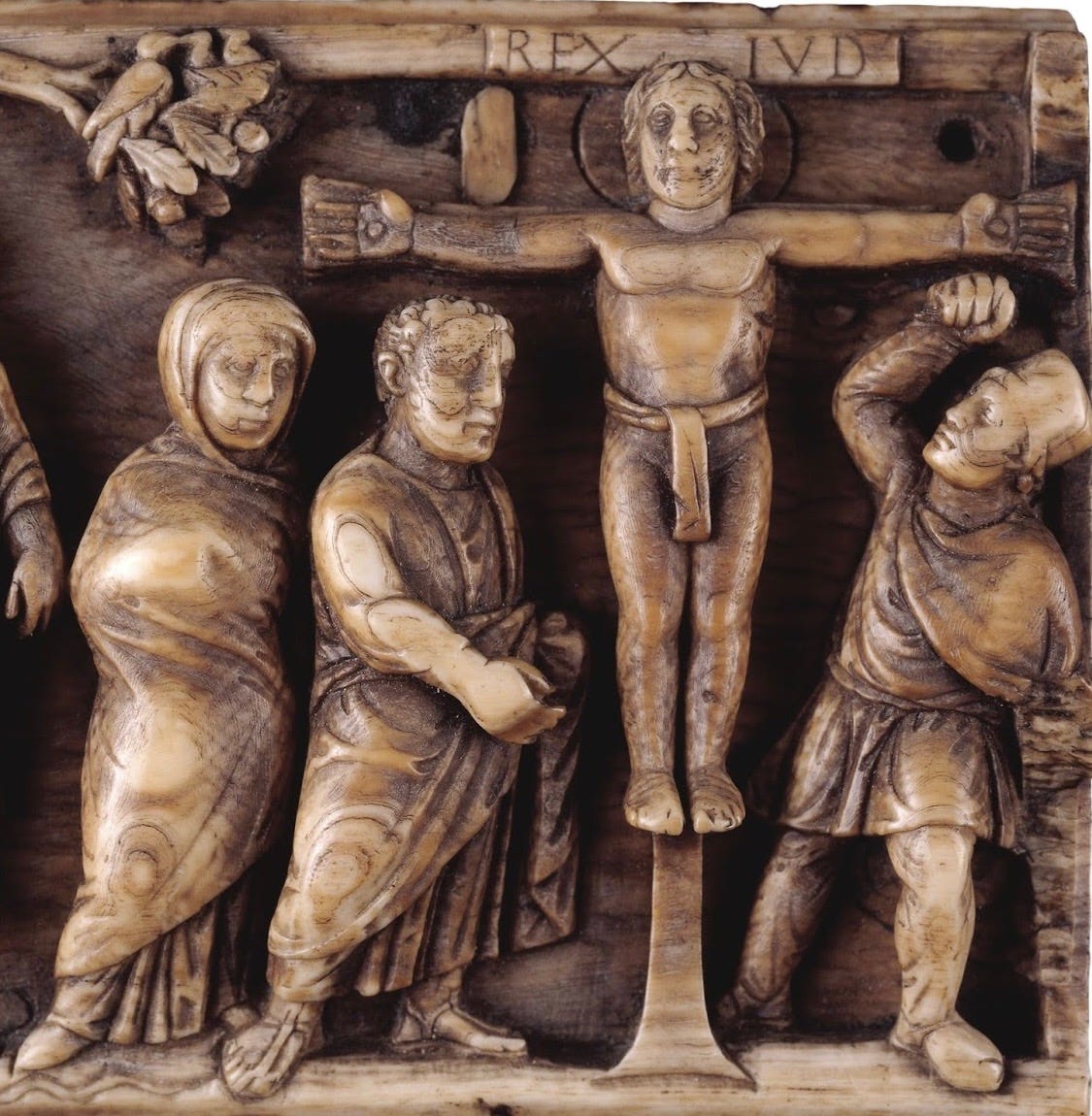
Here in John 17 the theme of glorification is like the idea of exaltation in John 3, a way of talking about the completion of Jesus’ work and his return to the Father. Jesus has shared his extended farewell discourse with the disciples (chapters 14-16), and as he addresses the Father Jesus now seems to slip out of the supper scene, and even out of history itself, into a conversation that takes place in eternity. Past, present, and future mingle as Jesus calls on the Father to glorify him, which means to receive him in heaven; but Jesus also speaks at some points as though this has already happened, or is happening at this very moment: “And now I am no longer in the world, but they are in the world, and I am coming to you” (v. 11).
The “glory” theme was introduced at the beginning of the Last Supper story— remember that this is still the setting, even though the disciples seem to have faded into the background—when, after Judas had gone out, Jesus proclaimed that his glorification was taking place then, or had already (see 13:31), linking his ascent with the act of betrayal that will lead to the Cross.
Jesus prays that the Father will glorify him (v.1), but claims that he has already been glorified in the disciples (v.11). He has been (is being, will be) glorified on earth, and now asks to be glorified with the Father. Glorification is thus equivalent to that “lifting up” spoken of earlier in the Gospel, but it also characterizes the community. Glory itself is recast in all this; while Roman autocrats, like more recent ones, might imagine golden statues, Jesus’ immense love and then that love manifest in the believers show what real glory amounts to.
Although Jesus has authority over “all flesh” (as v. 2 reads literally), “the world” remains alien. While all things came to be through him (1:3), “the world” (kosmos) here refers not to creation itself, or to “all flesh” (humanity), but to the present order of things. Hence “the world” did not know Jesus (1:10) despite his love for it (3:16). “The world” then is not so much a space as it is a regime; the power that rules is not the power of God, but God has nevertheless come to save, rescue, conquer in Jesus.
If the identity of ascension and Cross is one part of the distinctive Johannine approach, another is the mode of Jesus’ ongoing presence, in and for the community of believers. Because Jesus will be present to them, they will also be with him in glory. We have seen that John really does envisage a departure for Jesus, but uniquely emphasizes Jesus abiding in the community that he is leaving, through the work and being of the Paraclete. Divine presence in them (us), is also the believers’ presence in God. Because eternal life is to know God (v. 3), they already receive it and have themselves undergone a kind of transfer. Although they are still “in the world” (v.11), Jesus also says “ they no longer belong to the world” (v.16). Just as we saw time has been changed, space too—insofar as we think of heaven and earth as “spaces”—is not what it appears, because while living here they (and we) belong to the other realm where he is returning.
So the cycle of glory is being made complete, not so much because the body of Jesus is unaccounted for, but because his glory now belongs not only to him, but to those who love him. This community is not merely one pledging religious allegiance to him or borrowing his name to exercise power in the world in his name; rather it lives according to the truth that characterizes that other world to which its members belong, and to which he has returned. They are, to use the language of the Letter to the Hebrews (11:13), strangers and pilgrims now. Acting in love—a love which those who belong to the world, besotted with power and wealth, cannot recognize or even bear—the followers of Jesus witness to another world, whose glory is made known by the one who has returned to the Father yet abides with them still.
Thank you for these profound insights. Blessings, Tom
I have been on both ends, or sides , of the leave me/don't leave me. It takes enormous courage to be abandoned /left AND it takes just as much courage to abandon/leave. Either way, it hurts. Life in Divine promise is full of such experiences. Mostly I just choose, then pray, then find someone who loves me enough to share his own pushme/pullyou experiences—amidst tears and laughter of course.