
Gathering Fragments
10th after Pentecost/Proper 13, Year A 2026; Matt 14:13-21.

Matthew and the Gospels generally reflect ancient economic realities, including food insecurity. This was very evident in the Parables Discourse recently read; as one reader pointed out regarding last week’s parable of the Woman Leavening, the sheer quantity of the food being produced there seemed to anticipate another massive catering story, that now follows closely on.
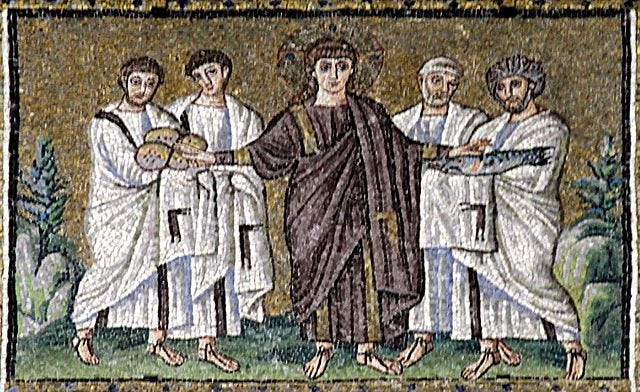
The Feeding of the Five Thousand is one of very few stories (other than the Passion and Resurrection narratives) found in all four Gospels. For later readers in more privileged settings, the spectacular nature of the miracle and its demonstration of Jesus’ power may distract us from the fact that it was loaves and fishes that were multiplied, and many hungry people fed. Hunger is the presenting issue here, just as it is in the petition “give us today our daily bread” in Jesus’ own prayer, which should be taken at face value—even if that is not all it means.
Jesus’ capacity to feed the people and desire to do so are intimately linked. None of the miracles or signs in the Gospels reflect mere power over nature or matter in some abstract way, as though merely to demonstrate that power, or divinity itself as power, but always to illustrate and make effective God’s love for his people. Divinity means this effective compassion.
Note that the story unfolds after people follow Jesus, seeking something unspecified but apparently including healing for the sick, which he offers first having “had compassion for them” (14:14), and then comes the feeding. So all this is an enactment of God’s Reign, demonstrating the benevolent character of Israel’s true king as he provides for the people, even while imperial overlords and the local cronies alike are extracting rents and tributes and produce arbitrarily.
This feeding story also echoes the Last Supper stories, and presumably also the eucharistic meals which the first readers of Matthew celebrated. Here Jesus “looked up to heaven, and blessed and broke the loaves, and gave them…” (14:19), clearly anticipating the later story where he “took a loaf of bread, and after blessing it he broke it, gave it to the disciples” (26:26). The same actions and sequence characterize both this miraculous meal and the fateful one to come.
This structural feature shared with the Last Supper is often referred to as a “four-fold” shape, and as something carried over into eucharistic practice too. Taking or presenting, blessing, breaking, and then distributing is a ritual pattern of all these stories. In all the miraculous feedings however—although not in the Last Supper— there is a fifth common element, namely the retrieval of leftovers. “They took up twelve baskets full of the broken pieces left over” (14:20) may just sound like cleaning up, as well as continuing the emphasis on plenty. But “broken pieces” (klasmata) does not mean scraps or crumbs; bread was always broken to share and eat it, so these are more like “portions” than scraps. The idea then is that Jesus’ provision extends beyond this moment, materially and otherwise.
The character of early Christian community as sort of feeding program is evident from other sources, too (see Acts 2). We even have a possible early reaction to this early importance of bread and feeding in John’s Gospel, where after the story of feeding the crowd (see John 6) Jesus criticizes those now following him, just because they “had their fill of the loaves” (John 6:26). These people have noted that there is indeed more bread where that came from. The importance of the complaint relies on context. We need more than bread, but we do need bread. It is not enough for us just to feed and be fed physically; but if these things are ignored in a world where hunger and poverty persist so scandalously, we are scarcely fulfilling the Gospel. Our attention to waste and need are not irrelevant even if they are not everything we need to attend to.
It is common for scholars to refer to this resonance with the Last Supper stories as though it makes the feeding miracles “Eucharistic.” If that means the very concrete story of the feeding is mainly a symbolic nod in advance first to the Last Supper and then to the sacramental meal, it would be a less helpful move. We might do better with the connections by reversing that logic. That is to say, when Jesus at the Last Supper acts as he had on a hillside months before to feed the poor and demonstrate the character of God’s Reign, we understand his final meal—and the sacrament that follows it— in the same terms of compassion, as signs of the regime he has proclaimed.
So the Last Supper is also a sign of that reign, and its own reference to Jesus’ coming death (cf. 1 Cor 11:26) encompasses the compassionate provision Jesus shows here, and how the reign of his one crucified as “King of the Jews” works. A celebration of the Eucharist that does not, prayerfully and practically, including enabling the community to meet the needs of the poor is not authentic to the meals that Jesus presents his friends and the crowds themselves as signs of himself and his mission. In our own somewhat different setting we might also ask how the ways we deal with waste are connected to our ecological crisis as well as to food insecurity.
The implications are hinted at in how the disciples act distinctively in Matthew’s version, in a way that fits the narrative of this Gospel and the continuing development of their ministry. Recall that the Parables Discourse (Matt 13) was not really about seeds and fish, but about the power of the Reign of God, and the distinctions it makes between those who hear and those who do not. The structure of that chapter showed the disciples were being educated and equipped, distinguishing themselves from those who had ears but did not hear, and receive the last part of the teaching by themselves. Now their own practice is to be developed further engaging with the crowds.
In Mark’s version of the story, the disciples—always a dim bunch in that Gospel—get into passive-aggressive territory when Jesus tells them to get involved in feeding the crowd, asking “Shall we go and buy two hundred denarii worth of bread, and give it to them to eat?” (Mark 6:37b). In Matthew this comment disappears; they are now willing, but lack the ability or confidence, saying only that their resources are limited (“We have only five loaves here and two fish”). The version of the Last-Supper-like formula in this case, with which Jesus takes the loaves, is shaped to emphasize their role: he “gave them to the disciples, and the disciples gave them to the crowds. And all ate and were filled” (vv.19-20).
The disciples themselves have now become the means by which this miracle takes place, just as clearly as when Jesus sent them earlier (chapter 10) to extend his mission. This story then functions as a model and a challenge to offer the bread of Jesus, literal and figurative, sacramental and substantial. Despite their lack of understanding, the disciples are able to share in his ministry. The test is not their sophistication or even the depth of their faith, but their willingness to accept the broken bread he gives and just share it; we are offered the same opportunity.
Further reading:
McGowan, Andrew. “The Fivefold Shape of the Eucharist: Abundance, Rubbish, and Ecology.” In Worship in Communion with Creation: Essays in Honor of Teresa Berger, edited by Melanie C. Ross and Karen Westerfield Tucker. Liturgical Press Academic, 2025.
The chapter is linked below.
For the complete book see https://litpress.org/Products/8904/Worship-in-Communion-with-Creation.
