

The shifts in Matthew’s parables discourse between crowd and disciples, story and explanation, reflect the themes of discernment and division in the parables themselves. The lectionary downplays this; so this week we get the impression that five short parables were offered to the crowds (v. 31), who were then asked (v. 51) whether they had understood. In fact Matthew had Jesus retreating “to the house” at v.36 (which was read last week) part way through this reading, and hence speaking only to the disciples after that. The question of who listens and understands persists.
The five are in two pairs (First the Mustard Seed, with a Woman Leavening, and then Treasure in a Field, with the Precious Pearl), followed by a fifth (The Net full of Fish). Matthew and Luke both add the Woman Leavening as pair to the Mustard Seed, taken over from Mark, but the last three are all unique to Matthew. Every one of them has something to do with economics, and three of them are related to food production. We must again imagine insecurity and poverty as a starting point.
The first, the Mustard Seed, seems to go against common sense or knowledge. Mustard—probably sinapis alba (white mustard)— is as likely to have been used as a pot-herb than as a source of the familiar spice. It indeed has a small seed, and the resulting plants are disproportionately large, but they do not grow into the “greatest of shrubs” or become “a tree for the birds of the air”; so this is not an ancient version of “mighty oaks from little acorns grow.” The unlikely mustard “tree” is not a common sense metaphor, but an image of God’s plenty in a renewed world. This is not how things seem to work, but how God’s reign works.
With the Woman Leavening, we can imagine hearers literally yearning for what is promised in the image, since—like the petition “give us today our daily bread”— it conjures the food insecurity that marked the lives of many. Although this time the scenario is plausible, these three “measures” of flour (cf. Gen 18:6) —maybe 40 liters in volume—are not just typical domestic provisions, but enough for a crowd.
The NRSV mistranslates one word; no-one in the ancient Mediterranean had “yeast” as a separate ingredient, but (as older translations tended to get right) “leaven,” which is a fermented mixture of flour and water. So in the Greek of the NT the woman look “leaven,” mixed it, and it all became “leavened.” The whole of the dough then becomes what the leaven was, appetizing as well as plentiful, and giving promise of further growth.
These two brief parables are followed by an editorial summary passage from the evangelist (vv. 34-35) about Jesus’ teaching, somewhat parallel to vv.10ff, but without the emphasis on incomprehension; now we are told that Jesus’ pedagogy is shaped this way to fulfill prophecy. However the earlier words about the relationship between this medium and rejection of him still apply; Jesus is not a moral teacher independently of his person and mission, which are good news for some but not, it seems, for all.
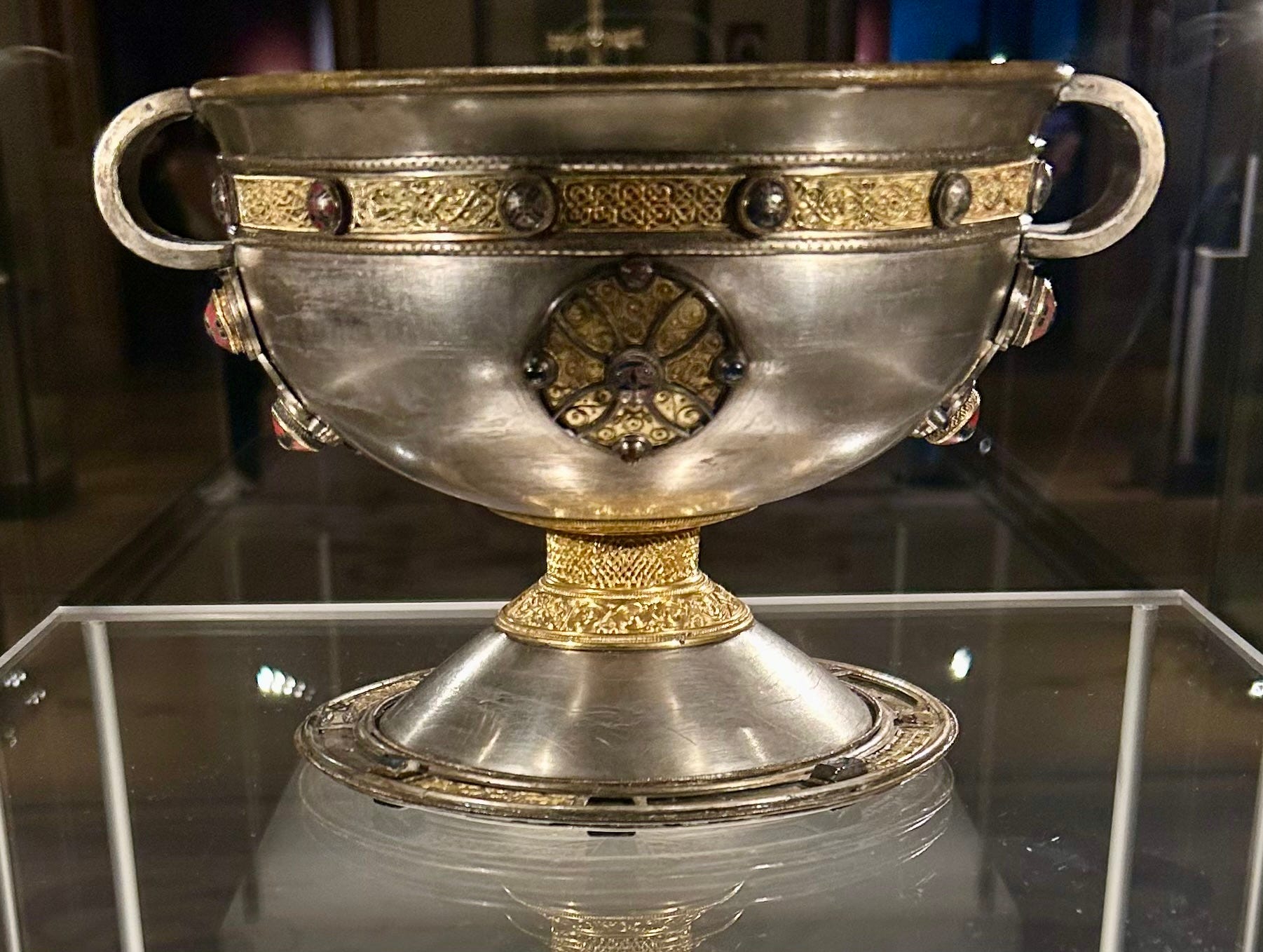
The remaining three parables, unique to Matthew, are presented as spoken privately to the disciples. The second pair, the Hidden Treasure and the Precious Pearl, again have obvious economic content for the ancient audience. People did bury treasure in fields. Even today, ploughs and metal detectors still reveal ancient hoards of coins and precious metals hidden in the ground, from Wales to Afghanistan to China. Without banks or safes, burial was often as good a means of protecting wealth as people had in times of trouble, but as the parable suggests, not always really effective. Peasants were more likely find a random treasure than to accumulate one.
The proverbial hoard here is clearly beyond the normal experience of Jesus’ hearers, but not their imaginations. There is an ethical problem if this is taken at face value, since nothing is said about the origins of the hoard, and it is theoretically the property of the current owner of the field. It’s like quietly paying $5 for that Old Master painting you’ve gleefully identified at the estate sale. This however isn’t the point. A parable is not a moral dilemma, but an image, of an exciting if unlikely prospect that galvanizes the imagination. The reign of God is like this. The reign of God is life-changing.
So too with the Precious Pearl—the merchant probably isn’t such a relatable figure to begin with, and his actions don’t really make any sense (it really does say “sell all that he has,” not “liquidate his other investments”). The point is that the reign of God turns things upside down.
The last parable, the Net, has common elements with the Wheat and the Tares read last week. Here various fish are caught, useful and not, and the explanation is embedded in the parable. Like Wheat and Tares, this image is both tantalizing and frustrating for people used to recurrent periods of hunger. Like the Wheat and the Tares though, it is ultimately an assurance of God’s good provision even when present circumstances are less promising. There are many points of contact here with Paul’s great vision of hope in Romans 8, both the section read last week, and then this week: “He who did not withhold his own Son, but gave him up for all of us, will he not with him also give us everything else?” (8:32)
Last comes the exchange between Jesus and the disciples with a simple and striking concluding question: “have you understood this?” “Yes,” they say, with perhaps an unwarranted confidence. Nevertheless Jesus commends them with the intriguing observation that “every scribe who has been trained for the kingdom of heaven is like a householder who brings out of his treasure what is new and what is old.” This is a description of the disciples’ vocation, itself framed as a parable (of course) that may nod to the previous two. It reflects Matthew’s thematic interest in maintaining adherence to the Law and Prophets as well as to the new thing God has done in Jesus (cf. 5:17)
The different conceptions that Matthew and the lectionary framers had may be clearer now. The parables discourse is a sort of micro-Gospel, a condensed version of the whole narrative of Matthew; its overall theme is the promise of God’s reign, in and despite rejection and apparent failure. The disciples in the end give their “yes” to Jesus, not because they have achieved an advanced certificate in parabolic interpretation, but because they are saying “yes” to him while others are not. They may still be hungry, but they have learned what they need most. The point was not folk wisdom, although it is received by the vulnerable and the dispossessed most fully; it was understanding how Jesus would be received, and that he would rise despite the appearance of failure. This is not because seeds grow or people stumble on treasures, but because God can overcome the barren ground, and the darnel, and lifeless dough, and all else, to make growth from what seems beyond hope, and life from out of death.
Great exegesis. I especially appreciate your accurate handling of the mustard seed metaphor.
Here’s an illustration I posted a while back, about finding unexpected treasure. (It’s behind the paywall now, but free subscribers get illustrations like this as they’re published.)
Everyone told Edwin Bailey that the pocket watch engraved with President Theodore Roosevelt’s name was a fake. But hundreds of hours of research convinced him it was the real deal, and the Florida auctioneer decided to sell it at a March 18, 2023, auction.
In the lead-up, a group of five well-dressed people came to his shop in Clearwater, Fla., wanting to inspect what Blackwell Auctions was describing online as possibly “the most historically significant item we’ve ever handled.” Bailey, now 58, was excited, figuring that a prospective buyer was so interested that they had sent a team of experts to examine it.
But after Bailey set the watch on a velvet-lined jewelry tray and put the starting bid at $50,000, one in the group told him that they were federal agents with the National Park Service and the FBI and then handed him a document.
“And this is a federal warrant authorizing the seizure of this watch and of all materials you have that are associated with it,” Bailey remembered the agent saying in a blog post he published Saturday.
On Thursday, officials returned the artifact to Roosevelt’s family home at Sagamore Hill National Historic Site in Oyster Bay, N.Y., on Long Island. Sagamore had owned and displayed the watch since his death in 1919. But a thief stole the watch in 1987 while it was being loaned to another historic site associated with the 26th president, and it fell off the radar for more than 35 years until Bailey started advertising his auction online….
A few minutes into the interview, a realization washed over Bailey, leading him to put his hands on either side of his face. An agent asked if he was all right. Bailey responded by smiling, laughing, tearing up and, since he was “downright giddy” while being interrogated by federal agents, looking “like a lunatic.” The agent once again asked if Bailey was okay.
“I was right!” Bailey blurted out to them. “Nobody I talked with — I mean nobody — believed this watch was Roosevelt’s. But I knew I was right!”….
“I got to play a role — however peripheral — in the recovery of a national treasure,” he wrote in the blog post. “I had the privilege of handling and researching arguably the most valued personal item carried by one of the four guys on Mount Rushmore.”
“And,” he added, “that’s enough for me.”
— Jonathan Edwards, “Teddy Roosevelt’s watch, stolen in 1987, turns up at Florida auction house,” Washington Post, July 2, 2024
https://www.washingtonpost.com/history/2024/07/02/theodore-roosevelt-pocket-watch-stolen-florida/
Retrieved March 15, 2026.
Sourdough "mother" is like this leaven.
But what i really like is: it's enough to feed a whole crowd. Maybe that's the "bread" divided among the crowd at the feeding of the five thousand.
Thanks!
In the Eucharist, we receive a sliver of (usually) unleavened bread; perhaps the Holy Spirit is the leaven there.
A host of images coming my way.
Your post is leaven, too!!