
A Persistent Widow and an Unjust Judge
Proper 24/19th after Pentecost Year C 2025; Luke 18:1-8

We have often had cause, while reading Luke’s parables, to recall that the worlds conjured in them are not the point, and that the ways figures act are not always meant to be exemplary. In the parable at the heart of this reading we have a case involving elements which are actively contrasted with how God acts, but also a scenario which does seem to tell us something important about the reign of God.
This parable of the “importunate”1 widow and the unjust judge, another unique to Luke, provides the unusual gift of an explicit statement from the evangelist about the purpose for which the story was told (“their need to pray always and not to lose heart,” v.1b), as well as further commentary from Jesus (vv. 6-8). Both of these help with interpretation, but there is even more to understanding the parable.
The lectionary has just skipped over a passage in which Jesus—still on the fateful journey to Jerusalem—begins to instruct the disciples about the nature of God’s reign, and in particular of the coming judgment and the end of time (17:20-37). The atmosphere now is not just one of general teaching about prayer but about apocalyptic drama and the uncertainly of God’s final revelation in human history.
In Luke, Jesus’ teaching on these issues (see also Luke 21) typically has cautions attached: the point is not to guess at the timing of some imminent end, but to live attentively in the present and not lose heart. The perseverance or hope which is now encouraged by this parable is thus more than a general moral lesson about persistence or discipline, or about prayer in general. The parable illustrates this life between the times, where we need to pray and not lose heart because things are indeed difficult, and difficult to understand. This is a first contextual clue to the meaning of the parable.
A second clue comes from the situation of the widow, or from Jesus’ choice of this scenario. The widow’s specific request here is never stated, but its general terms are easy to imagine. The status of widows in this society was especially vulnerable. Their place in the local patriarchal household, which was the basis of income security (and social existence in general) was moot. Numerous texts in both Testaments (Exod 22:22; Deut 27:9; Ps 94:6; Is 1:17; Luke 20:47 etc.) indicate that widows and orphans along with refugees (who often make up the third element of a trio—see Deut 10:18, 14:29; Jer 7:8 etc.) were people who inherently at risk. All these were often poor, and dependent either on the generosity of extended family where relevant, or on communal efforts such as setting aside part of harvests (Deut 14:28-9; Deut 24:19-10). Widows in particular were prey to unscrupulous behavior, such as having inherited property expropriated, or even by having landmarks of their holdings moved (see Prov 15:25).
So the situation of this proverbial widow is not just that of any litigant, but of the vulnerable who has been wronged, and who thus now seeks justice. The importance of justice here—not just as the social order in general, or provision of necessary support, but as actual juridical processes—also goes with the scenario. Biblical texts emphasize the importance of executing justice to vindicate the widow and those other oppressed ones; in fact God is often spoken of as a righteous judge whose concern for the widow was a sort of heavenly judicial relief (Deut 10:18, Ps 68:5, Is 1:17). Any scenario in which a widow seeks help from a judge is thus already a sort of set piece with scriptural resonance, not just a scene from everyday life—although it was that also. Someone has stolen this widow’s property, moved her landmark, or otherwise taken advantage of her status.
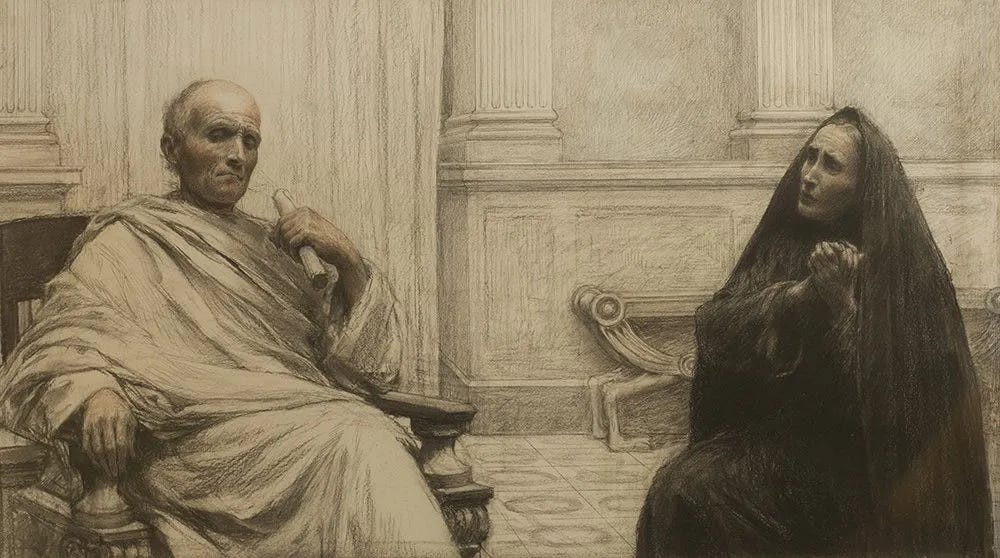
When we find that the judge of the parable is not a likable or responsive figure, quite clearly contrasted with the biblical ideal even of a human judge, we are reminded of how figures like the “unjust steward” function. In fact these two characters are described in exactly the same terms: neither fearing God (hence failing the standard expectation of defending the poor) nor respecting other people, this is a “judge of unrighteousness” (18:6; cf. 16:8). And as in that earlier case, the unpleasant figure is nevertheless a means of communicating something about how God’s reign works.
In this case, there is something like an explicit acknowledgement of how that can work, i.e., the difference between how we offer hopeful prayer to God and this widow of the parable:
And will not God grant justice to his chosen ones who cry to him day and night? Will he delay long in helping them? I tell you, he will quickly grant justice to them.
The unjust judge eventually offers the widow what she needs, because he can’t be bothered—as Luke Johnson says, this scenario is surely meant to be funny. The point is that God does not work this way, even when we wonder why we don’t get answers. If even a lousy leader occasionally does something fair just out of self-interest, how much more then will God answer those “who cry to him day and night.” The depth and the persistence of prayer are thus assumed, not because God needs to be hassled into responding, but because life is difficult and we do not always perceive the presence and action of God. We need nevertheless to persevere.
So the scenario involves elements both like and unlike the situation of the reader, and like and unlike God’s action in the world. First, the ones being encouraged to pray and not lose heart are indeed being compared to the widow, and her persistence is clearly an example that those hearing and reading are meant to follow. Yet there is more to this comparison.
We may miss that her situation is actually being offered as a parallel to the life of Jesus’ followers. He has just predicted times of struggle, and his own rejection and suffering (17:25). Those being addressed in the Gospel—including those reading now— are also seeking vindication and justice for the poorest. This may involve praying for our own needs and those of others of course, as existing understandings of prayer tend to emphasize; but first and foremost Jesus addresses those who know that prayer is part of living between the times. Discipleship means they—we—may be marginalized, if not by circumstances like hers, then by being faithful to the justice of God. Nevertheless, we pray.
The two contextual clues mentioned—the apocalyptic (that we pray waiting for God’s reign) and the socio-political (that we pray for the justice which is God’s reign)—make this teaching about prayer worth comparing to the form of prayer taught elsewhere by Jesus, and prayed daily by many. Prayer is always that “your kingdom (reign) come.” This is what the widow seeks too. When we understand this, we better understand the depth of our need to pray, and the nature of what we are asking.
Further reading: Luke Johson, The Gospel of Luke (Sacra Pagina).
Thanks to Misty Krasawski for research
A traditional title for the parable or this character, but unfortunately obsolete: “persistent,” basically.
While we wait, wait and wait some more, we also pray and perseverate, and it all adds up to the most-hated phrase a child, a sick person, an aging person, can hear: WAIT & SEE.
A great reminder. Life is made up of so many "in between times". We must keep the faith.
I really appreciate the acknowledgement of Jesus' humor. Many of the interactions He has make me laugh, many times He leaves his would-be accusers simply befuddled. I think it's easy to look past that and I'm thankful you've called it out!