
Fulfilling All Righteousness: The Story Begins
First Sunday after Epiphany (Baptism of the Lord), Year A; Matthew 3:13-17

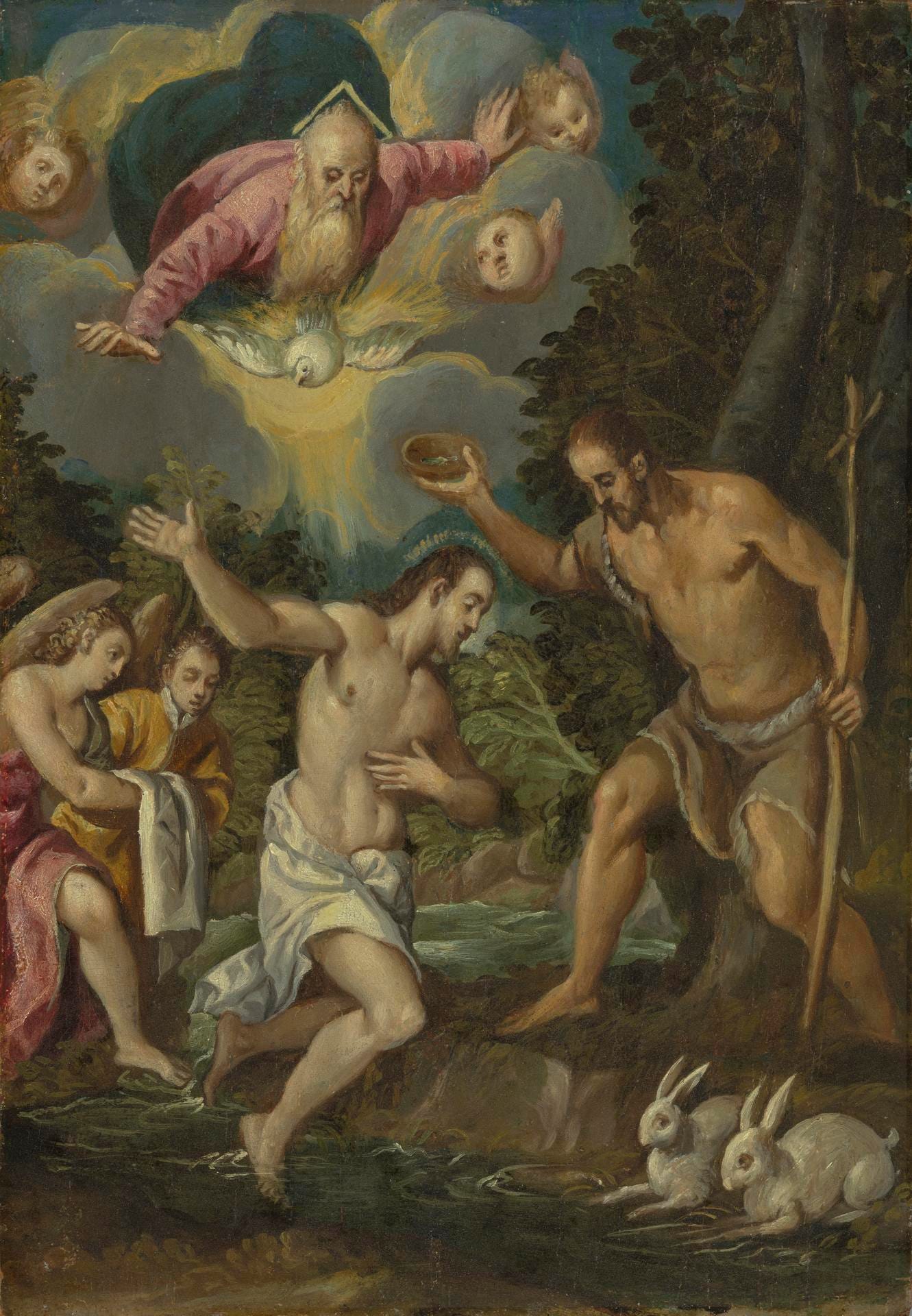
…after Matthew has described the situation in detail in 3:1-12—John, his baptism, and his preaching—the story finally begins.1
While scholar Ulrich Luz, quoted above, is probably referring mainly to the story of the baptism of Jesus, his comment applies to the Gospel as a whole. For all the intriguing and revelatory aspects of the infancy narrative, that was background or scene-setting; the real story begins now.
John had begun to baptize some time before this, by all accounts, and in Advent we read as much of his own back story as Matthew knows or is interested in— far less material than the stories from Luke. For Matthew, John had just “appeared” (3:1), or arrived as though from afar, and now Jesus does just the same (3:13). Even though we have been told quite a bit of Jesus’ own background, there remains an element of surprise at this jump from the last we had heard of him to the Nazarene now “appearing” at the Jordan with John.
Each evangelist reports this encounter in some form, but each account is distinctive. For Mark, in whose Gospel this baptism story is how Jesus himself is introduced for the first time, the starting point or challenge is not so much Jesus’ relationship with John, but how Jesus starts off at one with the people being baptized, part of the crowd. The Spirit’s descent then zooms in on Jesus and reveals his status as Son of God, and marks him out from the rest of the people even while establishing his solidarity with them.
Each of the subsequent gospels after Mark (of which perhaps all, but certainly Matthew and Luke, use Mark) seems to be negotiating a tension regarding the legacy of John the Baptist—a striking and memorable figure, apparently with a continued following when the Gospels are written—and the meaning of this story relative to Jesus. The baptism of Jesus is thus a key problem as well as a powerful story. Luke downplays the ritual washing itself and emphasizes Jesus’ experience of the Spirit; John the Evangelist does not even mention the baptism directly.
Matthew alone reports this almost poignant exchange, with John the Baptist’s self-effacement conveying something like awe before Jesus and reiterating their unequal relationship. The exchange reads as a further expression of the position John had put in vv. 11-12. That earlier proclamation, of the greater one coming and his relation to John, is a passage in common with Luke, hence usually thought of as “Q” material, but this intimate exchange here in Matthew is not. The need to negotiate this tension before the baptism so directly also makes more sense here, given what we have already learned in Matthew about Jesus’ origins and how it might seem to make the possibility of Jesus submitting to John’s baptism distinctly odd.
Jesus acknowledges John’s objection, which is of course just the logical consequence of his earlier assessment of their relationship (sandals and all); but the event is to go ahead, Jesus says, “to fulfill all righteousness.” This pithy phrase is not easy to unpack. “Righteousness” is a loaded word, and our assumptions about it may not quite help us to grasp the point here. Matthew uses it a lot—not least in the Beatitudes and the rest of the Sermon on the Mount (five times in chapters 5-7). Those cases are very important, because they indicate that “righteousness” is far more than keeping rules; it means the kind of disposition or reality described in the Sermon, as well as (we shall see) here, and even prior to this in Matthew’s narrative.
We have seen something of what righteousness is for Matthew before now, in the account of Joseph’s annunciation. There, Joseph’s being a “righteous” or just man (the Greek word is the same) was manifest not so much in Joseph keeping rules—straightforward adherence to which would have meant putting the awkwardly pregnant Mary away—but in exceeding what was required by rules, and acting with compassion. This does not mean that rules are unimportant, but it does mean they may not be enough.
Sometimes the term “fulfill all righteousness” has been misread in an almost opposite way; that is, as though Jesus’ “fulfillment” of the law meant its demands became irrelevant. At the risk of offering a spoiler, since these readings are just a couple of weeks off, the Beatitudes and the whole Sermon again show how righteousness demonstrates the character of the reign of God—or rather, for Matthew, the reign (or kingdom) of heaven—not as the negation of what had been shown of righteousness through the Law, but as something even more.
We will see there how Jesus teaches that the righteousness that characterizes the reign of heaven requires more of its members, rather than less; meeting the rules, as the Law of Moses may have seemed to define righteousness, can no longer be the point (and perhaps never was), but exceeding them might well be. And the character of this greater righteousness is not to be understood just by adding demands, or by applying greater rigorism, but by discerning that righteousness—a synonym for justice—which Joseph had showed, and which is the nature of Israel’s God. Righteousness is God’s remarkable saving love, above all, and for human beings that means our own righteousness is in keeping with that love.
How does this work here at the Jordan, though? The insistence by Jesus that he submit to the baptism of John is rather like his human father’s action regarding his mother, as far as it reveals what God’s righteousness is really like. John’s initial position, and his attempt to avoid baptizing Jesus, is a rule-based common sense approach to the dilemma with which he has been presented: Jesus the son of God is the one John had foretold as “greater than I,” and so to stay in his lane in the usual sense of “righteousness”—to just keep the rules—John should not presume to baptize him. Yet, Jesus suggests, to fulfill all righteousness—the righteousness of the God of Israel who has so often shown that mercy is stronger than reward, and that hope is stronger than despair, something different must happen.
Of course part of this is that the baptism has to take place. Matthew knew this had happened, and his readers did too; he seeks to help us understand that the story has a shape to which Jesus submits. The following events, the divine revelation or confirmation with the heavens opened and the dove descending, of course follow the baptism (itself not really emphasized, after all that) and reveal (again) what we know about Jesus but also confirm that this baptism was “righteous.” However odd it seems (and it seemed even odder to later theologians, worried about the chaos created for the idea of Jesus’ sinlessness), Jesus has to associate himself in baptism with John’s proclamation of the reign of heaven. This needs to happen, and in the very fact of his submission to John it shows us something about “righteousness,” about the reign of heaven, and about what it really means to be the beloved Son of God.
More than just being “the script needs to be followed,” Jesus’ act of submission to John’s baptism, and hence his solidarity with all those preparing for the reign of heaven, is in keeping with what he will across his teaching and ministry show to be the character of the reign of heaven, which is— righteousness. Righteousness is God’s saving mercy. To fulfill all righteousness for Jesus will not end here, but it begins here.
Thanks to Misty Krasawski for research.
Luz, Matthew, 140.
Thank you
It's easy to skip over the condition of the young girl Mary and her management of every young girl's worst fear AND greatest gift. EVERY young girl's greatest fear + her greatest gift, with a little help from her family and friends, eh? Forget about magical angels unless they represent the internal workings of LOVE in every story!!!