
Nicodemus is Born Again
Lent 2 Year A, 2026; John 3: 1-17

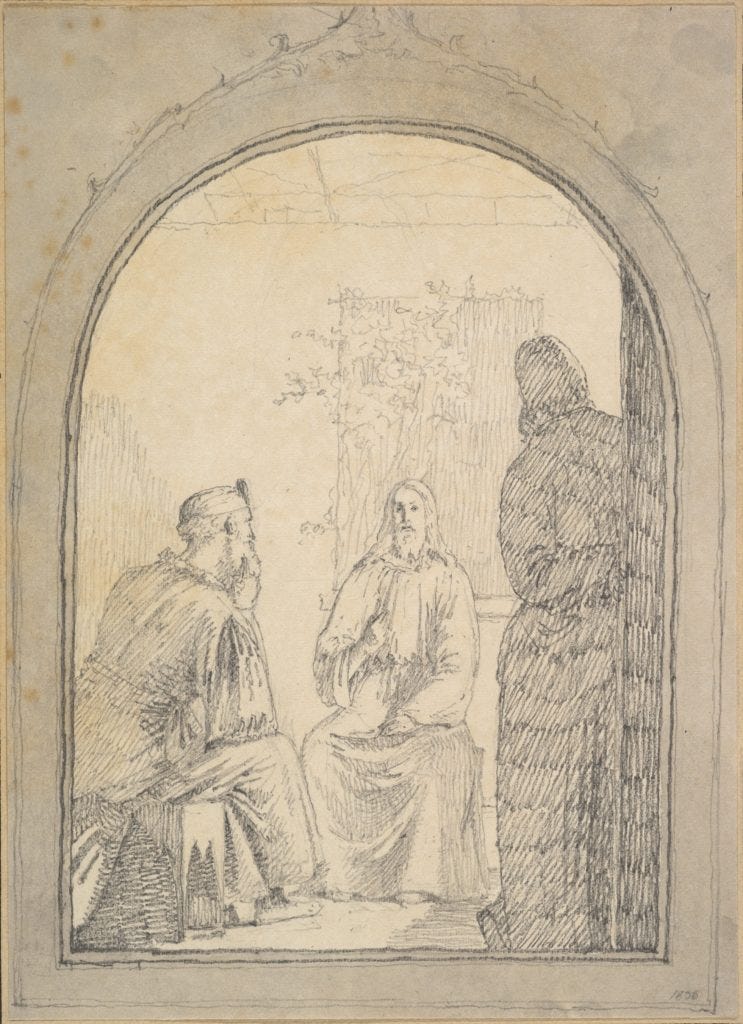
In this first of four Sunday readings from John’s Gospel during Lent, Jesus meets a leading figure among the Jewish people, a Pharisee named Nicodemus. Nicodemus—unknown outside this Gospel—appears twice more in John: the second time, at a sort of turning point in the narrative (7:50), where he represents a desire for fairness while arguing with his fellow leaders about Jesus; and then finally at Jesus’ burial, bringing a massive load of spices (19:39). Here, in this first appearance, Nicodemus is curious and tentative; in between, he is poised, and concerned with fairness; at the end, he has been changed.
This passage begins with a conversation, but the scenario—and Nicodemus with it— seems quickly to fade to black, with only Jesus speaking. Nicodemus does not appear after verse 9; the passage continues well after this, but it mostly reads as though Jesus alone is speaking to the reader, or to camera as it were. Some commentators even suggest Jesus’ speech might end at verse 15, so that the narrator goes on addressing us after that, in a way similar to the Prologue (ch. 1). This would include in the famous v. 16; but there is no way to tell if and where the speech ends, since ancient manuscripts contain little punctuation. Perhaps though there is a sense in which Jesus, the eternal Word, is always the real narrator of this Gospel anyway.
It is understandable that the narrative of the meeting with Nicodemus is not emphasized, but in particular the two most famous verses in it seem to have taken on a life of their own, the context forgotten: that is, the perennial favorite at 3:16, “God so loved the world…,” and the more contentious—and deliberately ambiguous—“you must be born anōthen” (3:7 etc.)—which means either or both “born again,” or “born from above.” Yet the story to which these belong may still turn out to be important to understanding them.
The quote about rebirth is especially hard to put back into context, because of the baggage it now carries regarding a specific type of personal conversion. Jesus is not referring to a modern “born again” conversion experience, like an altar call. This misunderstanding of “born again/from above” may however have produced an interpretive reaction, meaning some commentators are keener to point out what it doesn’t mean (an evangelical “decision for Christ”) than what it does. For this text is certainly about conversion, but as always in John we have to persevere to find out what that really means.
As already noted, the same Greek word means both “again” and “from above”; the interaction between Jesus and Nicodemus is driven (like so many conversations in John) by ambiguity that leads to misunderstanding. Nicodemus seems to think Jesus is talking about a literal second birth, which is a moment of humor.
The other possible translation, “born from above,” is meant to be at least part of a correct understanding here, over against Nicodemus’ literalism. Yet if we thought this meant the kingdom was for some people who are mysteriously “from above,” having a heavenly origin and destiny, rather than “born again,” this is merely to limit the text in a different way. There were those in early Christian circles who imagined that their Christian identity meant membership in a secret spiritual elite (a tendency sometimes referred to as “Gnosticism”). Yet this story suggests that the new and different realm, what is “above,” is available to Nicodemus, not merely the preserve of some predetermined group. So while Jesus is speaking of a heavenly birth, this is also a new birth.
To be born “from above” does not mean being “spiritual” in the vague sense now popular. The significance of “from above” is made clearer in vv. 12-15, where Jesus contrasts earthly and heavenly (i.e., “above”) things, revealing himself as the one whose movement between these realms, above and below, is the source of salvation.
However this doesn’t mean just that there is a higher realm to which we should aspire, but that he himself will be “lifted up” (v.14) so that all may see the mystery of salvation in the cross. “Above” therefore doesn’t just mean “spiritual” reality in a vague sense, it means a truth displayed in the exaltation of the crucified Jesus. The cross reveals what kind of “spiritual” reality the God of Jesus offers.
And only then, understanding that revelation of the kingdom of God, can the other great quote from this passage (v. 13) be understood: “God loved the world so much” that this gift of Jesus’ descent to dwell among us, and then his exaltation, are the act of self-giving divine love that enables the new life being discussed here for those who believe.
So understanding “born anōthen” requires maintaining the ambiguity, not resolving or denying it. Jesus does mean “your life must change in a way so radical that it is effectively rebirth” and “the changed character of your life will reveal that your true identity reflects a different reality.” The two meanings, “again” and “from above,” support one another.
The change Jesus calls for and offers is not just incremental or partial (even though it may not be instantaneous; more below), nor our own initiative or decision. We’re not in control of birth, after all. God’s invitation or demand is radical, and is the Spirit’s work (vv. 5-8), not our own. Recall, from the Prologue: “But to all who received him, who believed in his name, he gave power to become children of God, who were born not of blood, nor of the will of the flesh, nor of the will of a man, but of God” (1:13).
While intense religious experience and sacramental acts play their parts,1 they are not the rebirth. What is it, then? It is not a decision alone, neither is it baptism alone, although it may require both; it is God’s work in people’s lives, a transformation whose beginning may be less clear to us than its result. On that question—when it happens, and what it looks like— we might consider a clue in the Gospel via the story of Nicodemus.
Nicodemus had first come to Jesus at night secretly, and then in the middle of the story pondered Jesus judiciously, but at the end of the Gospel, after the Son has been exalted so to draw the world to himself, Nicodemus comes openly with his tremendous gift. There has been a change, perhaps involving some moment of decision never narrated, but more clearly depending with what Jesus has done, manifested now in the pierced body to which Nicodemus attends. Nicodemus has now been drawn into new life by the one who was lifted up to save the world. Not instantly, nor by his decision alone, Nicodemus has been born again, from above.
Keen readers will note that I haven’t tried to grapple with “water and the Spirit” this time!
We pondered this text in Church today, as many others did. One of the preacher's thoughts was on the Cross. Our images of Christ in this particular Church of three churches in the parish do not include the image of Jesus on the Cross, perhaps affecting visualisation and meditation on the true possibility of rebirth. However, as something to compare to, we have another parish church in the three, the Church of the Resurrection: This has a massive Leonard French window/ wall, of Jesus on the Cross, lifted, with images of the Ash Wednesday bushfires below,
Very good contextualised theology here that speaks volumes about the climate challenge and our current multiple fires across our state, yet again!
From above makes so much more sense. Thank you for this enlightening post. I have always been curious about Nicodemus. Not what we see or read but beneath that.